

The public space of Seestadt
50% of Seestadt is open and green space: from the lake park to neighborhood parks and a variety of squares and streets. In addition, green corridors connect the district with other parts of Vienna. Here, public space repeatedly becomes the “green living room” – making Seestadt a place with a high quality of life.
#Highlights


The lake
50,000 m² in the lake park: the lake is the heart, namesake, and main attraction of Seestadt – making open space the focal point of the district.

The parks
From neighborhood parks to large green areas – Seestadt’s parks invite you to exercise, play, and relax, strengthening community in the district.

The street spaces
In Seestadt, streets are more than roadways: places for walking, cycling, playing, and meeting – with little car traffic and lots of greenery.

Courtyards
Semi-public courtyards in Seestadt bridge the gap between private and public – as green oases for encounters and neighborhood life.

Green connections
Between Marchfeld and the Danube area, Seestadt is growing into Vienna’s green network – thanks to connecting green spaces in the east and west.

Shops & restaurants
Ground floor zones bring diversity to the district – with shops, restaurants, and spaces that enliven streets and neighborhoods.

Beds, additional trees, and water features make the Seeparkquartier "cooler" © Daniel Hawelka
Learning City: Participation and Flexibility
Seestadt is a learning city. Like trees, the district grows step by step. A city is never finished: requirements change, ideas emerge, and some things are reimagined. This flexibility also shapes public space – areas have been deliberately left open for future alternative uses. Participation has been central from the start: with the neighborhood budget or projects like Elinor-Ostrom-Park, residents and neighbors contributed their ideas. In addition, 8,900 m² are available for urban gardening, plus an organic self-harvest field by Ackerhelden. Neighborhood initiatives such as “SeeStadtgrün” are supported by the development company and the district management.
Freiraum First: Life Emerges Between Buildings
Freiraum First: Life Emerges Between Buildings


50% of Seestadt is dedicated to public space. © Daniel Hawelka
Strategy for open space planning
First the public spaces, then the buildings: In Seestadt, Wien 3420, with the Score for Public Space by Gehl Architects, has set new standards in open space planning. The lake, as the heart of the district, stands for this planning principle – the spirit of a city is created between the buildings. Public space acts as a driver for mobility, commerce, culture, leisure, and recreation.
About half of Seestadt will be accessible as public space upon completion; the guidelines for open space planning are based on the aforementioned Score for Public Space by the renowned Danish planners: Using four “strings,” the manual defines key axes in Seestadt that concentrate and unite the diverse functions of public space.
The four strings of public space
Like the strings of a musical instrument, public urban spaces are the drivers of a city, setting its life in motion.
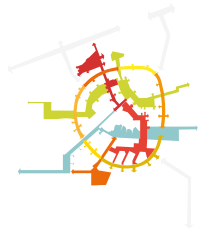
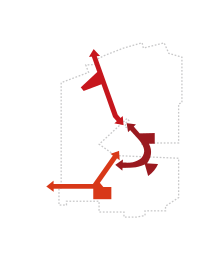
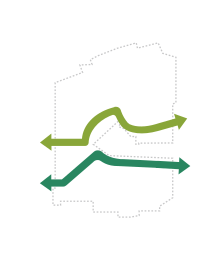
The Score for Public Space divides Seestadt into four “strings”: the urban Red String, the close-to-nature Green String, the connecting Sonnenallee (Yellow String), and the water-focused Blue String. Together, they create orientation, diversity, and a high quality of life.
The Red String is the urban lifeline of Seestadt. As a central axis, it connects squares, streets, and neighborhoods, creating an identity-shaping backbone for commerce, culture, and daily life. Varied spatial sequences and atmospheric densities make it a versatile urban space with a high quality of stay.
In the Red String North, it forms the Co-Creative Mile, the vibrant centerpiece between Nelson-Mandela-Platz and the lake. Here, commerce meets culture, gastronomy meets social offerings, creativity meets neighborhood. Widenings, narrowings, and squares create diverse atmospheres without losing the clear course of the axis. Together with the adjacent super courtyards and the Green String, this creates a dense network of open space and activity.
The Green String is more than a street – it connects parks, residential quarters, and surrounding green corridors into a continuous open space. With play zones, pocket parks, and community gardens, it becomes Seestadt’s green living room. Pedestrians and cyclists have priority here, and car traffic is extremely limited. This makes the Green String a safe, generation-friendly place that enables encounters, play, and movement in everyday life.
At the same time, it strengthens ecological diversity: green façades, gardens, and diverse planting create habitats for animals and plants. Thus, the Green String becomes a connecting axis – and a piece of nature in the middle of the city.
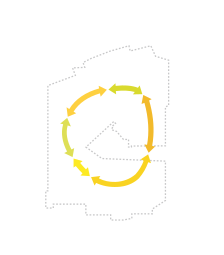
The Sonnenallee, also known as the Yellow String, is the connecting band of Seestadt. As a spacious ring road, it leads around the district, linking all quarters and connecting them to the main movement axes. It is one of the defining elements of the master plan and gives the urban space a clear shape.
With its size and design, Sonnenallee unites different forms of mobility: it bundles motorized traffic, offers wide paths for cyclists and pedestrians, and, with rows of trees and green strips, also provides quality spaces to linger. This makes it an urban axis that enables movement, orientation, and cohesion in Seestadt.
The Blue String makes water the identity-shaping element of Seestadt. It stands for vibrancy and sustainability and shows how water becomes a living space for people and nature. The asperner lake forms the centerpiece: it embodies the heart of the Blue String and shapes the image of the district like no other element.
Around the lake, a place is created that radiates far beyond Seestadt. When the full potential of the Blue String is realized, the lake will not only become the energetic center of Seestadt but also a meeting place for people from all over Vienna. In its clear orientation, it forms an exciting contrast to the urban, vibrant axis of the Red String – nature and water as a counterpoint to the dense city.


Whether young or old, woman, man, or non-binary: in Seestadt, public space is barrier-free, safe, and equally accessible for everyone.


Sponge city principle: Seestadt is a trailblazer in Vienna: subsoils are constructed to store more rainwater. Trees grow healthier, and flooding is reduced. Rain gardens, such as in Elinor-Ostrom-Park, further support a better microclimate.
#Goals
EVA Report: Goals for public space
The EVA Report makes visible how Seestadt pursues its high standards for open space: inclusive, climate-resilient, and versatile. Measurable indicators – from shading to degree of sealing to subjective quality perception – show whether the goals are being achieved.
EVA Report: Focus on mobility
The EVA Report records Seestadt’s mobility goals with clear KPIs: modal split, motorization rate, sharing options, or CO₂-free commercial transport. This makes it possible to verify how car-reduced living, safe routes, and life without a private car prove themselves in practice.